
A Good Hair Transplant Is the One You Don’t Notice: The Criteria for a Natural Result in Men
Dr. Sinan Akyürek explains natural male hair transplantation: hairline design, angle-direction-density, and the “undetectable result” philosophy. An honest, hype-free guide.
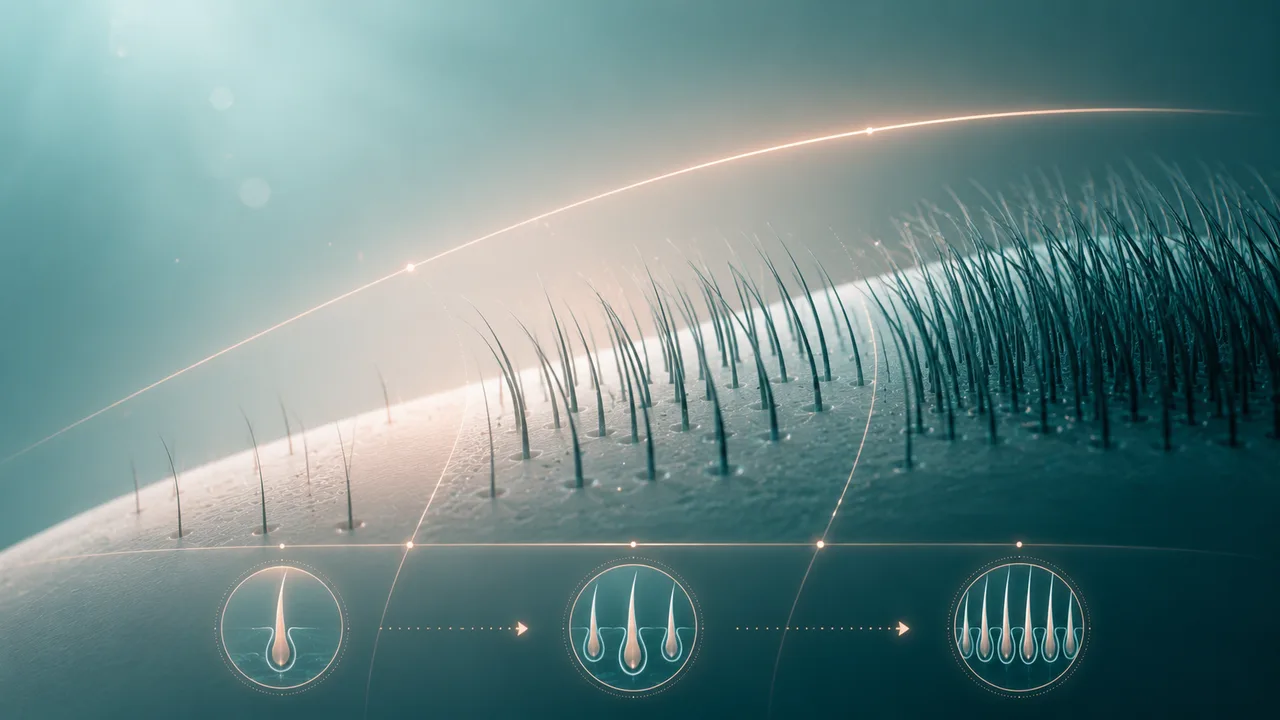
When I talk about hair transplantation with my male patients, the sentence I hear most often is this: “Doctor, I want it done — but I don’t want it to show.” I love that sentence, because it captures the whole point on its own. The success of a good hair transplant is not measured by how “full” it looks, but by how much it looks like nothing was ever done. Over the years I’ve come to see this clearly: a good hair transplant is the one you don’t notice. If the person passing you on the street doesn’t think “this man has had a transplant,” then the work was done correctly. Let me walk you through the logic behind that natural result, and how I plan it as a physician, calmly and in plain language.
What does an “undetectable result” actually mean?
Naturalness in a hair transplant is not something left to chance; it is a result designed from the very beginning. Most people picture a transplant as “moving follicles into an empty area,” but the real work is far more a problem of architecture than of moving roots. If you don’t build a design that fits the proportions of the face, the structure of the forehead, the person’s age, and the character of their existing hair, the result will look artificial even if every graft survives. When I evaluate a patient, I read the face before I read the hair — because the hairline is the frame of the face.
The secret to an undetectable result is imitation: faithfully imitating the way nature arranges hair. Natural hair is not random, but it is not mathematically ordered either; it carries a distinctive irregularity of its own. Recreating that “natural irregularity” is exactly what moves a hair transplant from a technical procedure toward something closer to craft. I consider this the very heart of hair transplant planning.
Hairline design — the single most critical decision
The one factor that decides whether a transplant looks natural or artificial is the design of the hairline. The warning I give most often to younger patients is this: the low, dense hairline you want today may not look natural ten years from now. Hair loss is an ongoing process, and I have to plan not only for today but for years down the road. A hairline built in an age-appropriate, natural position stays natural for a lifetime; a line pulled aggressively downward eventually reads like a “wig edge.”
When I design a hairline, I never draw a single straight line — no such line exists in nature. I build a soft transition that is slightly irregular, micro-waved, and uses finer, single grafts at the very front. This transition zone is where density gradually increases from the forehead toward the scalp, and it is the area that most gives away — or most rescues — the naturalness of the result. I often approach it from the perspective of a full facial analysis, because the hairline has to remain in harmony with the eyebrows and the overall proportions of the face.
The four technical criteria of a natural look
My patients often ask me, “Why does the work you do look more natural?” The answer isn’t a single magic technique; it’s several details done correctly at the same time. I list the technical criteria that make a result look natural like this:
- Angle: Every graft must be placed to match exactly the natural exit angle of the hair in that region. Hair planted upright never looks natural.
- Direction: Hair direction changes from region to region across the scalp; even the swirl (whorl) at the crown must be imitated.
- Density distribution: Single grafts at the front, denser multi-grafts behind — density must increase gradually, not uniformly.
- Donor area management: The donor zone at the nape must be thinned in a balanced way so it still looks natural in the future; grafts must never be over-harvested from a single point.
If even one of these criteria is skipped, the eye reads “something is off” even when every graft survives. Naturalness is precisely getting all four of these settings right at once.

Micro-grafts and how the process works
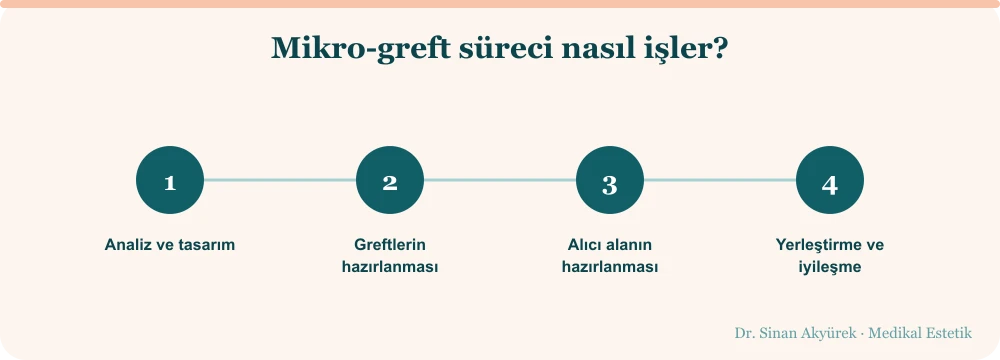
At the center of the approach I use today is the logic of micro-grafts: harvesting and placing follicles, together with the tissue around them, in very small groups (follicular units). This delicacy both minimizes any trace in the donor area and creates a more natural distribution in the transplanted region. I usually describe the process to my patients in these steps:
- Analysis and design: Facial proportions, the pattern of hair loss, and donor-area capacity are assessed, and the hairline is drawn.
- Preparing the grafts: Follicular units are separated one by one, preserving their viability.
- Preparing the recipient area: Micro-channels are opened at the correct angle and direction — this is the most critical stage for naturalness.
- Placement and healing: Grafts are placed according to the density plan; mild crusting in the first days is normal.
The aftercare matters as much as the procedure itself. I explain the sensitivity of the first week in detail to my patients, because proper healing is part of the process.
Realistic expectations: time and patience
The subject that generates the most mistaken expectations in hair transplantation is timing. The transplanted hairs usually shed within the first weeks — this is called “shock loss” and is entirely normal; the roots stay in place, only the hair shafts fall out temporarily. The real growth happens gradually over months, and the final result usually takes about a year to mature. I say this honestly from the start, because someone who arrives expecting to “be a different person in three months” may worry needlessly during this realistic but patience-demanding process.
I also have to say this plainly: a hair transplant is not suitable for everyone and is not ideal at every age. In a young patient whose donor area is insufficient, or whose loss is active and progressing quickly, I sometimes say, “not now — let’s bring the shedding under control first.” Done in the right patient, with the right design and realistic expectations, a hair transplant gives a strong and lasting result — but that decision can only be clarified through a face-to-face evaluation.
Sources & Further Reading
- American Academy of Dermatology — hair loss types and treatment options
- Cleveland Clinic — hair transplant overview
- Mayo Clinic — male-pattern hair loss
- Republic of Türkiye — TİTCK (regulatory authority)
A good hair transplant doesn’t shout; it whispers. My goal is a result no one calls “a transplant,” while you recognize yourself in the mirror — naturalness depends on design, not on luck.
Looking for a natural plan for your hairline? Plan a free consultation on WhatsApp.