Regenerative Medicine and Stem Cells: What Do They Actually Mean in Aesthetics?
What does regenerative medicine really do in aesthetics — and what does it never promise? Dr. Sinan Akyürek draws an honest, unexaggerated line from a holistic medical perspective.

“Stem cells” is only two words, but the expectation that lights up in a patient’s eyes when I say them in consultation is often far beyond what the science actually promises. For some it is a miracle; for others an expensive fashion; for others still, something close to science fiction. Regenerative medicine is none of these. It is a real field — with real boundaries — that deserves to be discussed carefully. I have spoken about this on national television as well, because misinformation here is particularly dangerous. In this article I want to speak in the language of a physician rather than a marketer: what regenerative medicine genuinely means in aesthetics, what it does, and what it does not do.
What is regenerative medicine, and where do stem cells sit?
At its simplest, regenerative medicine is an approach that aims to awaken the body’s own capacity for repair. Much of classical medicine works by suppressing a problem with an external substance. Regenerative medicine instead tries to send the tissue a different signal: repair yourself. Stem cells are the most-discussed — and most over-hyped — part of that framework.
Stem cells are the body’s cells that have not yet “decided what to become.” They carry the potential to differentiate into various tissue types and to support repair processes. In aesthetics, however, the approaches used most often draw not on the cells themselves but on the signalling molecules they produce — growth factors and exosomes.
In other words, what you frequently hear described as “stem cell treatment” is usually not the direct transplantation of stem cells, but the regenerative biology that surrounds them. This distinction matters enormously, because most exaggerated claims feed precisely on that blurred line. When someone cannot tell you clearly which of the two they mean, that is your first signal to slow down and ask more questions.
From Cerrahpaşa to holistic medicine: why this perspective?
I came to medicine through the classical route and then deepened my practice with a holistic perspective. These two do not contradict each other; they complete each other.
Classical medicine taught me evidence and doubt: if there is a claim, I ask what supports it. The holistic perspective taught me not to see the face as a set of isolated regions, and to evaluate the person as a whole — sleep, stress, nutrition, hormonal balance and skin health are not separate files.
Regenerative medicine sits exactly at that intersection. Used correctly, it is a genuinely powerful tool that mobilises the skin’s and the tissue’s own resources. But the moment someone says it “solves everything,” it is no longer medicine speaking — it is marketing. My job is to show the patient that line honestly: the excitement and the limit.
What does it genuinely help with in aesthetics?
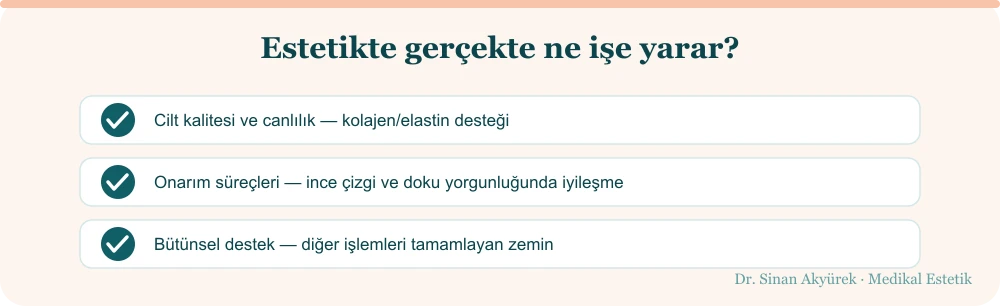
The area where regenerative approaches make the most sense in aesthetics is tissue quality. To speak concretely:
- Skin quality and vitality: By stimulating fibroblasts, collagen and elastin production is supported, and the skin looks more hydrated and more resilient.
- Repair processes: Gradual improvement in fine lines, tissue fatigue, and that overall “dull” appearance.
- Holistic support: Sometimes it forms the ground layer that completes other procedures — for example exosome applications or MCT Exo-Tech.
Notice that every one of these revolves around the words quality and support. That is where the real strength of regenerative medicine in aesthetics lies. The next section is every bit as important — arguably more so.
What it does NOT do — honest limits
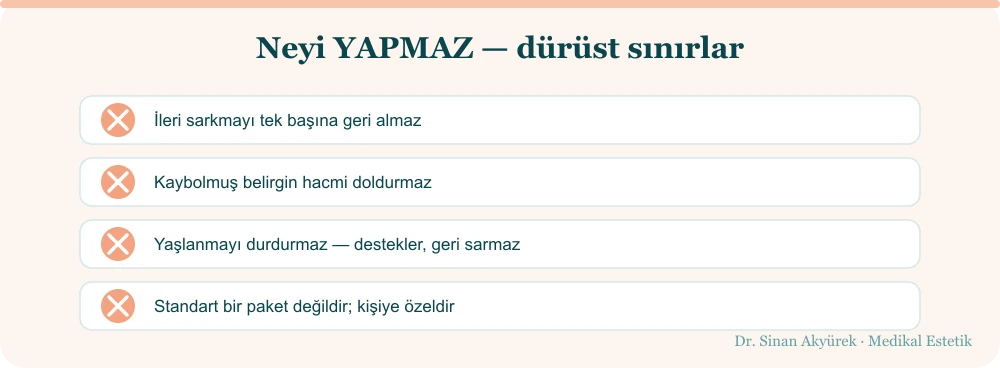
An article without this section would be incomplete. Regenerative medicine is not a magic wand:
- It does not reverse advanced sagging. Where there is pronounced tissue laxity, the conversation belongs to surgical or thread-lift methods; stem cells alone will not do that job.
- It does not fill lost volume. Where there is significant volume deficit, a balanced filler plan is the more truthful answer.
- It does not stop ageing. It can support and slow the process; it does not rewind time.
- It is not a standard “package.” The plan, the number of sessions and the realistic expectation change from person to person.
When a patient arrives expecting to “look ten years younger in a single session,” my first task is to bring that expectation gently back to reality. Satisfaction begins with the right expectation — not with the boldest promise.
Safety and regulation: the quiet but most important heading
Regenerative applications are medical procedures and must be treated with that seriousness. In Türkiye, stem cell and advanced regenerative applications are regulated: it is defined where and under what conditions a given application may be performed. The great majority of “miracle stem cell” content circulating online conforms neither to that framework nor to scientific reality.
When a treatment is proposed to you, the questions you should ask are simple. What is the scientific basis for this? Is it within the legal framework? What exactly is being promised to me — and what is not being promised? An honest physician will welcome all three questions.
My own approach is clear: use an exciting field within its realistic and safe boundaries. Neither reject it blindly nor inflate it. In the right patient, with the right indication and the right expectation, regenerative medicine is genuinely valuable. Whether it is meaningful for you is something we can only establish face to face, with a holistic assessment.
Sources and Further Reading
- Cleveland Clinic — what is regenerative medicine
- PubMed — literature on stem cells and skin rejuvenation
- Mayo Clinic — about regenerative medicine
- Republic of Türkiye Ministry of Health — TİTCK
Regenerative medicine is neither a miracle nor a fashion; in the right patient, within the right limits, it is real. The difference lies not in the claim, but in the honesty.
Are regenerative approaches right for you? Plan a free consultation on WhatsApp.