What Is Profhilo, and How Is It Different From Filler?
Dr. Sinan Akyürek explains how Profhilo differs from filler, how the BAP injection points work, how many sessions are needed and when results appear.

There is a scene I see often at consultations. The patient stands in front of the mirror, gently pinches the cheek between two fingers and says, “My creams don’t seem to work any more, my skin looks thirsty.” The complaint usually comes with exactly this sentence. Most of these patients actually have no clear volume loss. The face is where it should be. What has been lost is the tissue itself, its quality.
Profhilo fits into this gap. Yet it often gets put on the wrong shelf, the filler shelf. Both are made from the same raw material, hyaluronic acid. That makes them relatives, but it doesn’t mean they do the same job.
So what is Profhilo, precisely?
I’ll explain what it is first, and the rest will be easier to follow. Hyaluronic acid is a molecule our body makes itself, and it gathers water around it. In conventional fillers this molecule is locked together with cross-links. It takes on a gel consistency, stays where it is placed and creates volume there. That is the whole purpose.
Profhilo has no cross-linker. Its concentration is high, but its consistency is fluid. So it doesn’t sit as a lump at the injection point. It spreads into the tissue. Where it spreads, we expect it to do two things. It binds water and supports the skin’s capacity to hold moisture, and it nudges the fibroblasts, the collagen factories, into action. In the literature this is called bio-remodelling, reshaping the tissue.
So we add no volume from the outside. What we aim for is to wake up the skin’s own production. Crumple a fresh leaf and let go, and it goes back to its shape. A dry leaf crackles and breaks apart in your hand. With skin that has lost its water, the first thing to look at is that lost water.
Where does it part ways with filler?
Filler reminds me of the poles that hold up a tent canvas. It puts support in one place, changes the form, lifts an area that has dropped. Profhilo deals with the fabric of the canvas itself. They are two separate answers to two different questions.
Why does this distinction matter? A mismatch costs time, and it also leads the patient to the wrong conclusion. If the support in the cheekbone area has really decreased, Profhilo won’t bring that support back. The reverse is also true. If your skin looks dull, thin and dehydrated, a filler treatment won’t refresh that tissue. Then people say, “It didn’t work for me.” In fact the procedure was done correctly; it was simply chosen as the answer to the wrong question.
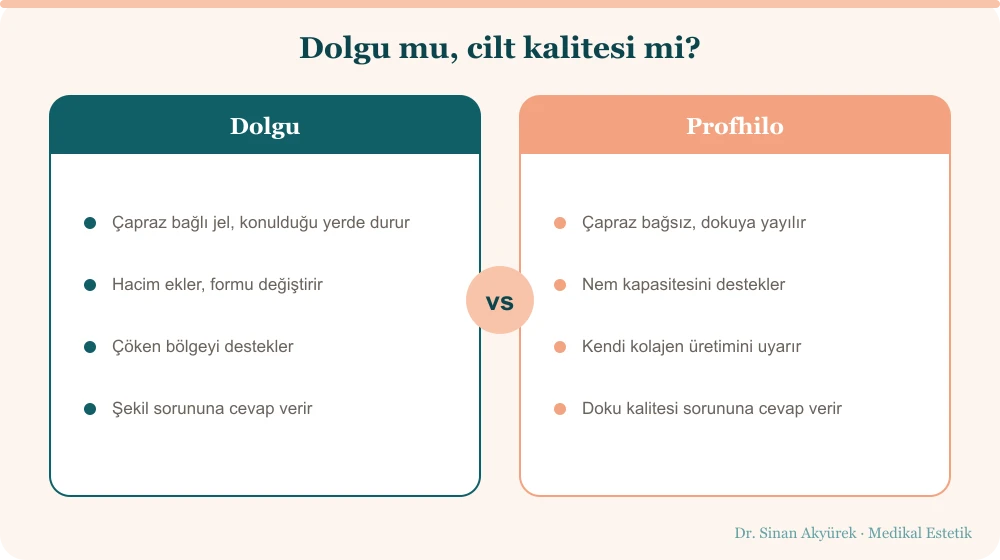
At the consultation, the first thing I look at is this: does what bothers you in the mirror come from volume or from tissue? I don’t build a plan until I have separated these two.
BAP points: why only ten injections?
The way Profhilo is applied is also different from conventional filler. It uses defined points called BAP (Bio Aesthetic Points), five on each half of the face. These points weren’t chosen at random. They were defined with the map of the vessels and nerves in mind, as the places where the product can spread over the widest area and where the needle is safest.
So ten injections are enough for the whole face, and the product does the rest by spreading on its own. It is one of the products I like. You inject five points on each side, and it both firms the skin and gives a strong moisturising effect. The procedure takes about 15 minutes. The small bumps that form after the injections settle within a few hours.
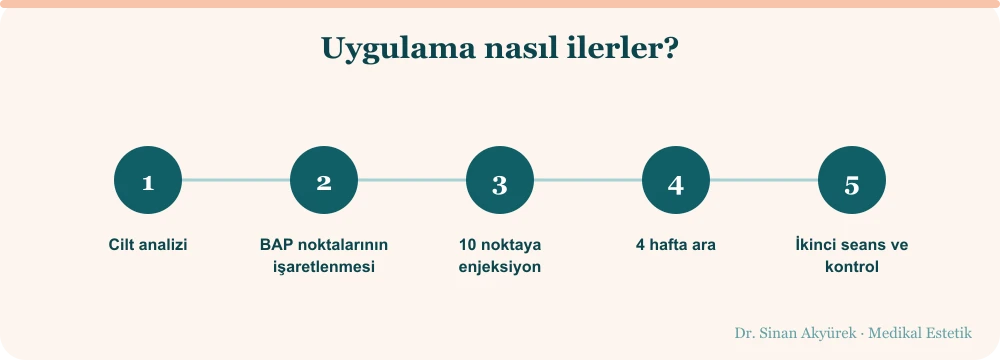
The standard protocol is two sessions four weeks apart. We still plan the number of sessions for each person. Skin thickness, age, sun history and the patient’s expectations can change this decision.
Who is it for, and who is it not for?
In my experience, the best responders are patients who have no clear volume loss but whose tissue quality has dropped. Dullness, thinning and fine lines settling in from the mid-thirties onwards belong to this picture. Besides the face, we can also treat the neck, the décolletage and the back of the hands. On the back of the hands the result catches the eye sooner than on the face.
We can also plan it together with other treatments aimed at skin quality. We use salmon DNA more on the repair side and mesotherapy on the vitamin and mineral support side. Which one comes first depends on what the skin needs at that point.
I’ll be honest: on a face with clear sagging, Profhilo unfortunately won’t give a surgical result. It firms up some of the laxity and revives the tissue, but it has a ceiling, and we talk about that ceiling at the start of the consultation. We don’t apply it during pregnancy and breastfeeding, when there is an active skin infection in the treatment area, or when there is a known allergy to the product’s ingredients.
When do results appear, and how long do they hold?
This needs a little patience. You won’t look in the mirror on your way out and say “that’s it”, because what we are waiting for is your skin’s own production. Brightness and a feeling of fullness usually become clear four to eight weeks after the second session. The effect is expected to last 6-12 months. After that, it is maintained with one refresher session a year.
How long it actually lasts depends largely on you. You cannot compare someone who smokes three packs a day with someone who has never smoked. We help your tissue recover; protecting it is your homework. Sunscreen, enough water, regular sleep and not smoking keep working far longer than the 15 minutes I spend on the procedure.
Sources & Further Reading
- Turkish Medicines and Medical Devices Agency (TİTCK) — regulation, safety and promotion rules for medical devices and products: titck.gov.tr
- American Academy of Dermatology — skin ageing, the moisture barrier and the role of sun protection: aad.org
- PubMed — peer-reviewed literature on hyaluronic acid and bio-remodelling: pubmed.ncbi.nlm.nih.gov
- Cleveland Clinic — general patient guidance on what hyaluronic acid does in the skin: my.clevelandclinic.org