
Filler or Biological Renewal? MCT Exo-Tech, Explained in Plain Language
What is MCT Exo-Tech and how does it differ from classic filler? Dr. Sinan Akyürek explains the regenerative approach that triggers the skin's own renewal instead of adding volume.

One of the sentences I hear most often in consultations these days goes like this: “Doctor, I don’t want filler — but my skin looks tired, and I want something done.” That single sentence tells me a great deal. What the patient is really asking for is not added volume; it is for their skin to come back to life. This is exactly the point where I start talking about regenerative approaches such as MCT Exo-Tech. But before we go any further, one misunderstanding needs to be cleared up: this is not “a stronger kind of filler.” It is an entirely different philosophy. Let me unpack it calmly, the way I would in my consultation room.
Filler and biological renewal are not the same thing
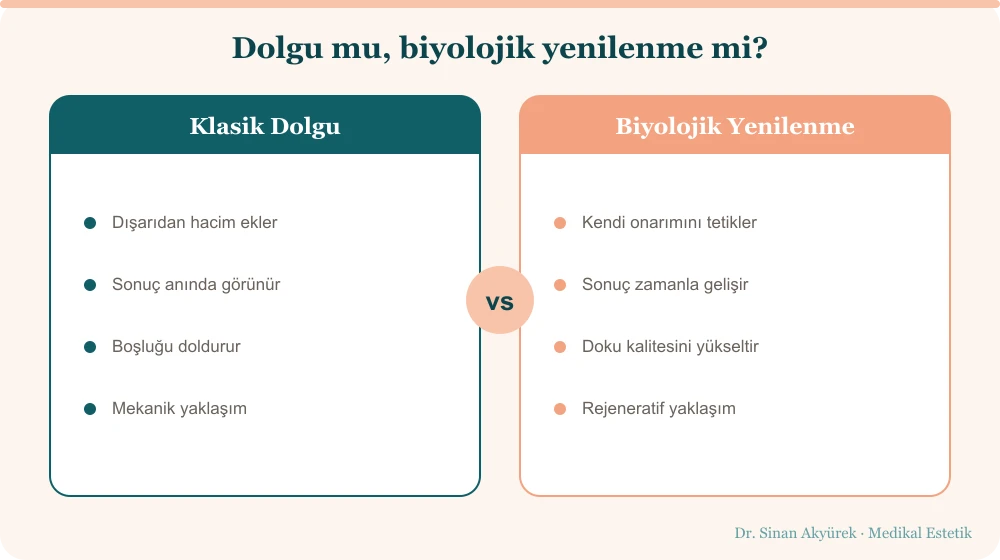
The logic of classic filler is simple. Where there is volume loss, you place a material from the outside — most commonly hyaluronic acid — and you fill the gap. The result is immediate and mechanical, rather like plumping up a deflated cushion. When it is planned correctly, filler is an extremely valuable tool, and I use it often in my own practice. Nothing in this article is an argument against filler.
Biological renewal works from the opposite direction. The aim is not to fill a space with an external material, but to encourage the skin’s own cells to start working again. Instead of telling the skin “take this,” you are telling it “remember how to repair yourself.” MCT Exo-Tech belongs to this second family. The goal is not to change the architecture of the face from the outside; it is to raise the quality of the tissue from within.
In my experience, patients who grasp this distinction immediately understand why I recommend filler in some situations and a regenerative protocol in others. They are not competing treatments; they answer different questions. Filler answers “where is the volume missing?” Regenerative treatment answers “why has the tissue lost its vitality?”
What exactly does MCT Exo-Tech do?
MCT Exo-Tech is a tissue-repair approach that brings together exosome and bio-implant technology. The name sounds technical, but the logic is surprisingly intuitive.
Exosomes are tiny “information packages” that cells use to send messages to one another. Inside them travel growth factors and cellular signals. When these signals reach the skin, the collagen-producing cells we call fibroblasts are switched back into action. Think of a workshop where the craftsmen have gradually stopped showing up: exosomes are the letters that call them back to work.
The key word here is trigger. We are not placing ready-made collagen into the skin from outside; we are stimulating the skin’s own collagen and elastin production. The bio-implant component adds something equally important: it provides the tissue with a scaffold — a stable ground — so that this repair process can proceed in an organised way rather than haphazardly.
I explain it to my patients with a simple analogy. Filler is like carrying furniture into an empty room: fast, visible, effective. The regenerative approach is like re-hiring the room’s own repair crew: slower, quieter, but it changes the building itself. Both are valuable — they simply do very different jobs.
Who is it actually suitable for?
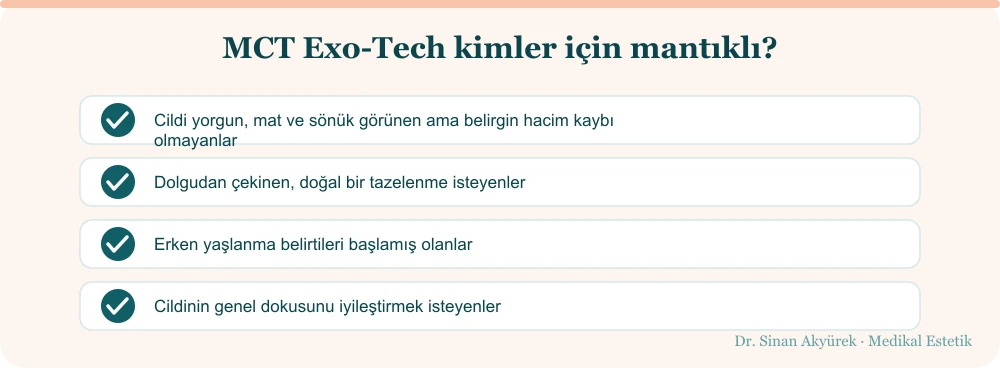
No treatment is right for everyone, and if I am honest, there are consultations where I tell a patient plainly, “this is not what you need.” That honesty is part of the job. Still, there is a clear profile of people for whom MCT Exo-Tech makes real sense:
- Skin that looks tired, dull and deflated without a significant volume deficit — in other words, the problem is quality, not empty space.
- Patients who are hesitant about filler and want a natural refresh. People who want to hear “you look rested,” not “you look different.”
- Early signs of ageing — fine lines, early loss of elasticity — where the aim is to slow the process down rather than reverse a dramatic change.
- People who have had various procedures before and now want to improve the overall texture and health of their skin rather than chase another isolated fix.
On the other hand, if there is genuine, pronounced volume loss — for example a serious reduction in cheekbone support — a regenerative treatment on its own will not fill that gap. In that situation, a balanced filler plan is the more truthful answer. This is precisely why I never decide on the basis of a single procedure; I read the face as a whole and then choose the tools.
How many sessions, and when do you see results?
This is the most asked question, and the one where expectations most often go wrong. By their very nature, regenerative treatments do not deliver instant results — because what you are waiting for is the skin’s own production line to start up again.
I usually plan a protocol of several sessions, with deliberate gaps in between so the skin has time to do its work. The exact number varies from person to person; skin condition, age and expectations all shape the plan. Anyone who promises a fixed universal number is, in my view, not being straight with you.
In the first weeks, most patients notice an increase in glow and hydration. The real change — the improvement in tissue quality — matures over a few months. I say this openly at the very first consultation, because someone who arrives expecting to “wake up different tomorrow” can be disappointed by a process that is real but gradual. In regenerative medicine, patience is part of the treatment. The result is not miraculous; it is genuine, and it is your own.
Realistic expectations: what it does, and what it does not
I care about this section more than any other, because honest expectation-setting sits at the centre of how I practise. MCT Exo-Tech supports skin quality, encourages the tissue to repair itself, and restores a sense of freshness and hydration. What it does not do is suspend gravity. It will not, on its own, correct significant sagging, and it does not switch off the ageing process.
The best results come from the right patient and the right plan. In some cases I evaluate the regenerative approach within a broader framework alongside stem-cell and other regenerative methods; in others, the honest answer is a simpler maintenance protocol. The aim is never to follow a trend — it is to read what your skin actually needs. And that is something we can only settle together, face to face.
Sources and Further Reading
- PubMed — scientific literature on exosomes and skin regeneration
- Cleveland Clinic — what is regenerative medicine
- American Academy of Dermatology — skin rejuvenation procedures
- Republic of Türkiye Ministry of Health — TİTCK
If filler is carrying furniture into a room, biological renewal is re-hiring the room’s own repair crew. Both are valuable — what matters is reading correctly which one your skin needs.
Filler or renewal — which is right for your skin? Plan a free consultation on WhatsApp.