Is Filler Addictive? The Real Answer to “Once You Start, You Can Never Stop”
Dr. Sinan Akyürek explains whether filler is addictive, why it dissolves in 6-18 months, where the “cannot stop” feeling comes from, how pillow face forms and what the right interval is.

“Doctor, I’ve heard that once you have filler, you can never stop. Is that true?” I hear this question very often in consultations. Usually the patient asks it at the last moment, just as they are about to decide. Behind the question there are two separate fears. One is “will my body come to need this?” The other is “will I slowly turn into one of those swollen faces?” Both have a reason, and each needs its own answer.
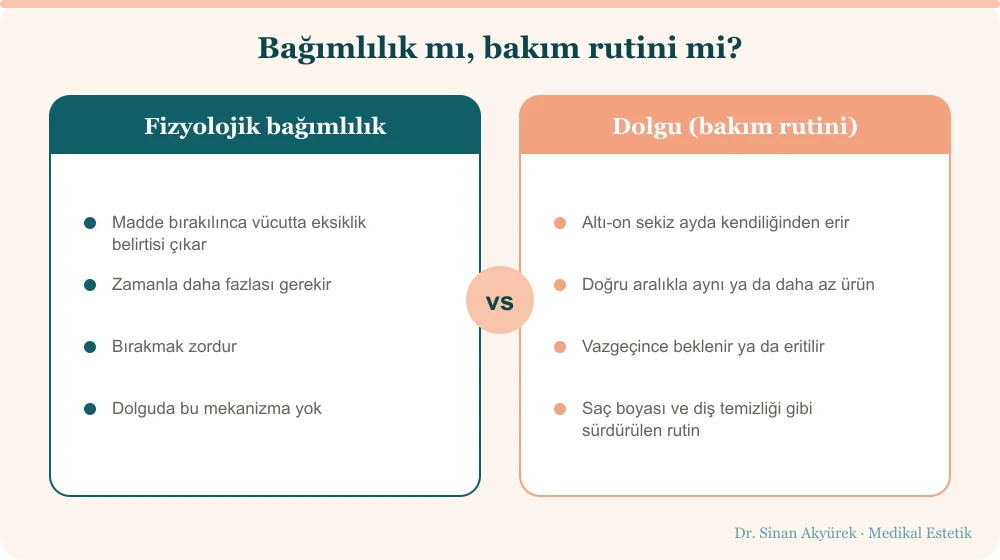
First, let me say what addiction means. In medicine, addiction means the body getting used to a substance until it can no longer function without it. When the substance is stopped, the body shows the lack through symptoms. There is no such mechanism with filler. But the “can’t stop” feeling is something real. That feeling comes from somewhere else entirely.
Does filler stay in the body for good?
No. It dissolves. Most of the filler products we use today are hyaluronic acid. This molecule is already present in your skin, your joints and your eyes. It holds water and gives tissue its fullness. The form we inject as filler is the same molecule with its chains linked to one another, so it breaks down more slowly.
Our body has an enzyme called hyaluronidase. It takes the injected filler apart, piece by piece, over months. Depending on the density of the product, the area treated and your own metabolism, the effect of the filler fades somewhere between six and eighteen months. It dissolves faster in an area that moves a lot, like the lips, and more slowly in a still area like the cheekbone. A patient who looks in the mirror a year later and says “my filler has worn off” is right. The body has done its job.
I should add one thing here. The effect fading does not mean the filler has completely left the tissue. Part of it stays there for longer. I’ll explain why that matters further down, when I come to the swollen faces.
Where does the “I can’t stop” feeling come from?
If hyaluronic acid dissolves and goes, why do so many people say “once you start, you can’t stop”? To be honest, several separate things get mixed up here. None of them counts as physiological dependence.
First, the eye gets used to the new face. When we place a measured amount of volume in your cheekbone, you notice it in the mirror for the first two weeks. Then that face becomes your face. The brain quickly accepts the new look as normal.
Second, as the filler dissolves you go back to how you were, but now you see “before” more clearly. Before the treatment, you had slowly accepted the volume loss in your cheekbone over the years without even being aware of it. Filler showed you what that area looks like when it is full. When it dissolves, the difference shows again, and this time your eye has a reference to compare against.
Third, liking the result. People can become attached to anything that makes them feel good, and I won’t deny that. Some of my patients love the result, enjoy looking good for their age and want to continue. But no one has to have it done. Nothing happens in the body of someone who stops; only the appearance returns to how it was. That’s why I see filler as a form of maintenance that is temporary, repeatable and can be stopped whenever you wish. The guidance of honest friends around you, and of the physician doing the treatment, matters a great deal here. An approach that says “a little more” every time leads to the bad examples I describe below.
There is another group of patients. When they stop filler, they feel their face is “missing something” and they experience this as anxiety. The feeling is real, and I don’t make light of it. Most of the time it comes from expectations not being discussed properly at the start. When we say at the consultation, “this is temporary, the effect will fade somewhere between six and eighteen months, and we’ll decide again then,” most of that anxiety never begins.
So what about those swollen faces?
By this point the patient is relaxing. Then they take out their phone and show me a photo. Cheeks like balloons, eyes that look smaller, an expression that has been wiped away. “I don’t want to look like this, Doctor. I don’t want to end up all puffed up.” They are right. What people call “pillow face,” and what we call overfilled syndrome, is real. What causes it is how the filler is used, and how often.
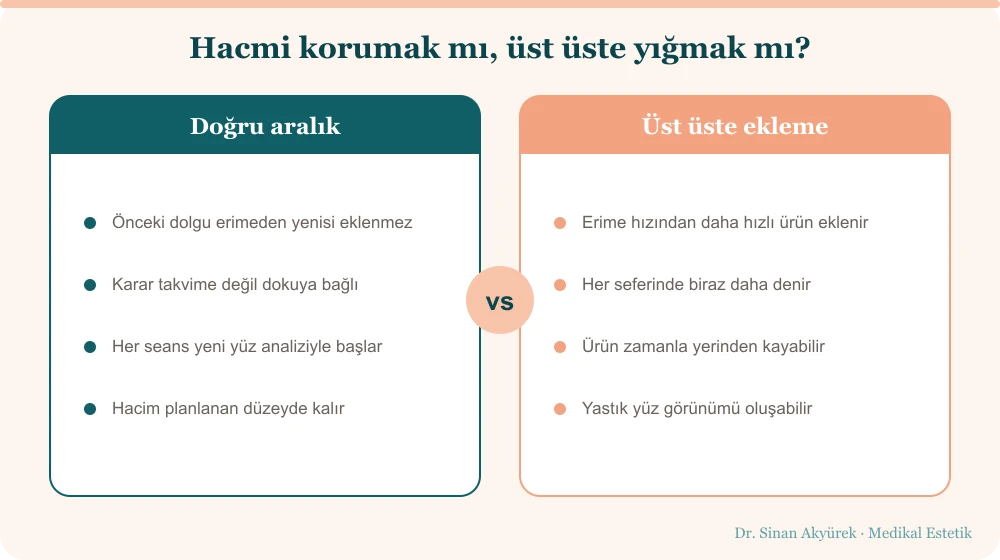
It develops like this. The patient comes back every six months. The effect of the previous filler has faded, but the filler itself hasn’t left the tissue yet. A new amount is added on top, and each time it is “just a little more.” Five years later, that area holds two or three times the volume that was planned. Add to this a slight drift of the filler away from where it was placed, which we call migration. Because filler is a gel, under the pull of gravity it can spread a little toward the fat tissue nearby. It doesn’t move to a distant part of the face. Combined with the volume that has built up, though, it makes the face’s own lines disappear. You can create a build-up even with a product that isn’t permanent. All it takes is adding it faster than it dissolves.
The approach that assumes one more will always be better produces these bad examples. With the right technique and a measured amount, we don’t expect to see this picture. If it has developed, hyaluronic acid filler can be dissolved to correct it.
How often should it be repeated?
I don’t add new filler before the effect of the previous one has passed. I see my patient for a check-up within the first month after treatment, and if needed we do a small touch-up. Later, when they ask “when should I come back?”, I don’t give a date. I say, “come when you notice it in the mirror.” The state of the tissue decides the timing. Some of my patients come back at twelve months, some after two years. Both are right.
When they come, we look at the face again. In two years the face changes, weight changes, priorities change. The volume we placed in the cheekbone last time may not be needed this time; perhaps the jawline has become the priority. Sometimes we say, “no filler this time, we’ll work on skin quality instead.” Every session starts again with a facial analysis. Simply repeating the previous prescription wouldn’t be right.
Unfortunately, filler doesn’t stop ageing. The face keeps changing in every layer, from bone to fat and from muscle to skin, and filler touches only one of these: volume. So if more filler is needed five years later, the reason is the five years that have passed.
What happens if you change your mind?
What eases the fear of “not being able to stop” most is knowing where the exit is. A patient of mine who wants to give up filler has two options. The first is to do nothing. Within six to eighteen months the effect fades on its own and the face returns to how it looked before. The second, for a patient who doesn’t want to wait, is filler dissolving. We apply a concentrated form of the hyaluronidase enzyme to the area, and the filler breaks down within days.
When I explain this at the consultation, I can see the patient relax. Knowing that a decision can be undone makes it easier to make.
Of course, dissolving is a medical procedure too. It has its own rules, and it isn’t the first choice in every case. For most of my patients, “we’ll wait and let it go on its own” is enough.
Maintenance or addiction?
You can ask yourself a few questions. When the filler is gone, does your body show any sign of deficiency? It doesn’t; only the appearance returns to how it was. Do you need more product each time? Not if it is done at the right interval. The same amount, sometimes less, is enough. Is new product being added before the old one has dissolved? If so, the problem lies in the plan. When you want to stop, can you? Yes, either by waiting or by dissolving.
Sources & Further Reading
- American Academy of Dermatology — general patient information on dermal fillers: aad.org
- PubMed — literature on the longevity of hyaluronic acid fillers and hyaluronidase: pubmed.ncbi.nlm.nih.gov
- Cleveland Clinic — what dermal fillers are and how long they last: my.clevelandclinic.org
- Turkish Medicines and Medical Devices Agency (TİTCK) — product and practice regulation: titck.gov.tr