Salmon DNA (Polynucleotides): What It Actually Is and What It Does
Dr. Sinan Akyürek explains what salmon DNA really is, how it differs from filler and mesotherapy, what it does under the eyes and who should avoid it.

If you ask me which procedure gets the most questions because of its name, I’ll say this one without a second thought. The patient sits down and asks, a little hesitantly: “Doctor, is it really fish DNA going into my face?” I understand that unease very well. The name really does sound strange.
What we call salmon DNA has nothing to do with the fish or with your own genetics. The name only tells you where the raw material comes from. I’ll explain what that means first, and the rest will be easier to follow.
So what is salmon DNA, precisely?
In our language it is called a polynucleotide. Nucleotides are the bricks of the DNA chain. Short chains made of these bricks are obtained from the milt of salmon. They are then purified, and the long sequences that carry genetic information are broken down. What you are left with is only the building blocks.
Why salmon? Salmon DNA is a molecule known for its similarity to human DNA. The nucleotide chains of this fish behave quite close to human tissue, and our immune system doesn’t see them as a foreign threat. That is also what allows it to help repair the skin.
Once they are placed in the tissue, we expect two things. First, these chains form a network that binds water. Second, and this one matters more to me, they invite the fibroblasts, the collagen factories, to get to work. In practice we see this as livelier skin, softer fine lines and a greater capacity to hold water. It also helps the appearance of pores and pigment spots. It lightens spots, although it can’t make them disappear.
Think of the skin as a layer of sponge. A dried-out sponge keeps its shape, but it has lost its water and the elasticity of its inner structure. Polynucleotide aims both to give that sponge its water back and to help it repair its inner structure.
Where does it part ways with filler and mesotherapy?
These three often come up in the same sentence, so people mix them up, but one can’t stand in for another.
Filler is a matter of form. It puts support into an area that has sunk, brings back volume and changes proportions. Classic mesotherapy is a matter of nourishment. It carries a mix of vitamins, minerals and amino acids into the skin and supports the tissue. Polynucleotide answers a third question: can the tissue repair itself?
So in my clinic I count it among the repair procedures, and I build the plan accordingly.
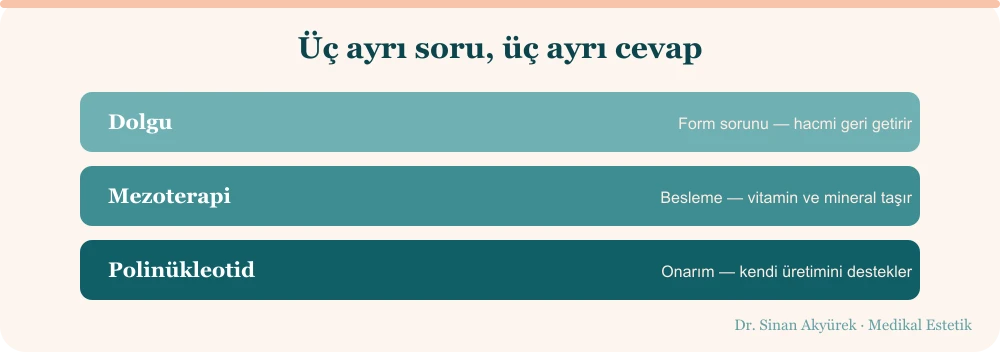
Can these three be used together in the same patient? Often, yes, with the order planned.
Why does everyone talk about it for the under-eye area?
The skin under the eye is the thinnest skin on the body, in some places well under a millimetre. This thinness makes the work harder, and it also makes polynucleotide valuable in this area. Adding volume here isn’t always the right answer. Sometimes the problem is in the skin itself. The skin has thinned and become translucent, and the vessels underneath have started to show.
In a picture like this, helping the tissue thicken and firm up is a smarter move than adding volume. The same logic applies to fine lines. Not every salmon DNA product suits the under-eye area, though. Some of them can cause quite a lot of swelling, so we choose a separate product for under the eyes.
I prefer to talk about what we can’t do before we talk about what we can. The puffiness we call an under-eye bag is the fat pad underneath pushing forward like a small hernia. Unfortunately, polynucleotide won’t remove that bag, and if anyone tells you it will, don’t believe them. If the dark circle is caused entirely by pigment, our target is different too. Then an under-eye light approach or another protocol comes in.
The session plan and the real timeline
The usual plan is 3-4 sessions, two to three weeks apart. The procedure takes 15-20 minutes, and we apply a numbing cream beforehand.
This is the part that needs patience. You won’t look in the mirror on your way out and say “that’s it”. What we are waiting for is production by your own cells, and that has its own timing. A difference in the light and texture of the skin usually starts after the second session. We assess the real picture a few weeks after the course is finished.
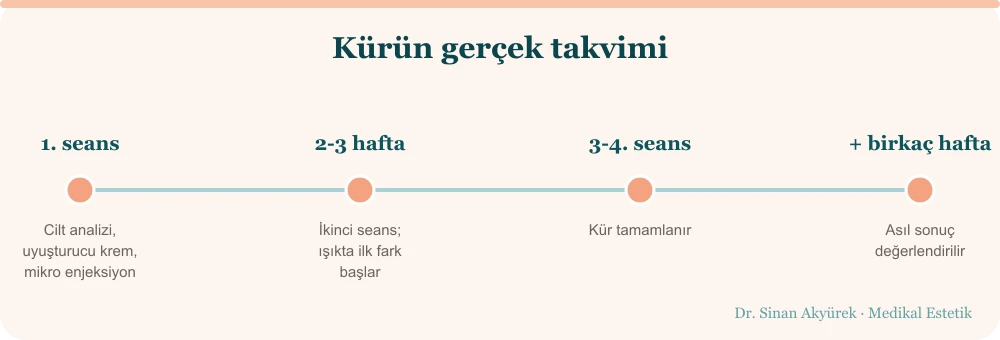
After the procedure there may be small bumps that last a few hours and, rarely, tiny bruises. You go back to your social life the same day.
Who is it for, and who is it not for?
In my experience the best responders are patients with no clear volume loss whose skin has become thinner and duller, with more visible fine lines. The eye area, cheeks, neck and the back of the hands are the regions we work on most often. We also plan it as repair support after energy-device treatments or peels.
The situations where it isn’t suitable are clear as well: pregnancy and breastfeeding, an active skin infection in the treatment area, uncontrolled autoimmune disease and a known serious allergy to fish products. I don’t insist with a patient who has a history of allergy. There are other protocols.
As I tell every patient, we help your tissue recover; protecting it is your homework. Sunscreen, sleep, water and smoking decide how long the effect of the course lasts much more than I do.
Sources & Further Reading
- Turkish Ministry of Health / TİTCK — licensing, safety and advertising regulations for medical devices and products: titck.gov.tr
- PubMed — peer-reviewed literature on polynucleotides and tissue repair: pubmed.ncbi.nlm.nih.gov
- American Academy of Dermatology — skin ageing, the moisture barrier and the role of sun protection: aad.org
- Cleveland Clinic — general patient guidance on dark circles under the eyes and their causes: my.clevelandclinic.org