Waking Up With a Tired Jaw: What Masseter Botox Does and Does Not Do
Dr. Sinan Akyürek explains how masseter Botox helps with jaw clenching, why it softens the lower face, how long it lasts and who should not have it.

“Doctor, I wake up in the morning and my jaw is tired, as if it has been working all night.” I hear this sentence often in consultations. The patient who says it usually hasn’t come because of jaw pain. They come because they feel the lower half of their face has widened over the last few years and the corners of the jaw have become heavier.
They are surprised to hear that both have to do with the same muscle. Let me describe that muscle first; the rest is easier to follow after that.
Why does the masseter grow?
Put your fingers on the corner of your jaw, a little in front of your earlobe, and clench your teeth. The muscle that hardens and bulges under your hand is the masseter. It runs from beneath the cheekbone down to the angle of the lower jaw and is the main engine of chewing. Don’t be misled by its size: it is one of the strongest muscles in the body.
Muscles grow as they are used. If you work your arm every day, your biceps gets thicker. The difference with the masseter is that it works without you knowing. Behind masseter enlargement there is usually bruxism, the habit of clenching and grinding the teeth. Most of this happens during sleep and goes on for hours. During the day you can notice it and stop yourself. At night there is nobody to stop you.
The body is thrifty; it doesn’t do anything for nothing. It thickens a muscle that is strained every night. So over the years the lower face widens, the triangular proportion of the face shifts toward a square, and the jaw corners become more pronounced. What my patient describes as “maybe my face has swollen” is very often the thickened muscle itself.
Stress, poor sleep, caffeine in the evening and a mismatch in the way the teeth meet are the main things that feed this picture. Clenching rarely comes alone, either. Morning headaches, tension in the temples, clicking in the jaw joint and even wear on the tooth enamel can all be part of the same picture.
What does Botox do here?
I will start by correcting a common misconception. Botulinum toxin doesn’t cut, remove or dissolve the muscle. For a muscle to contract, a “contract” message has to come from the nerve. Botulinum toxin closes off the junction where the nerve meets the muscle, almost like putty. The message can’t fully reach the muscle. In the masseter, our aim is to reduce the muscle’s strength.
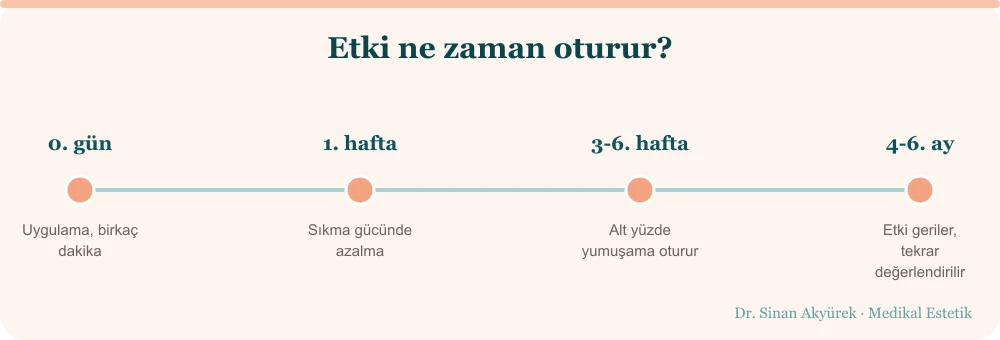
When the muscle contracts less, two things happen. The first is felt quickly. The effect of Botox varies from person to person, but it generally starts within the first two or three days. Clenching strength drops, and the nightly load on the jaw joint and the teeth eases. The second becomes visible over time. A muscle that works less doesn’t keep its bulk, so it thins. That’s why the softening of the lower face doesn’t appear on day one. It usually settles in somewhere between three and six weeks. I tell my patients not to look for the result of this treatment in the mirror the next morning.
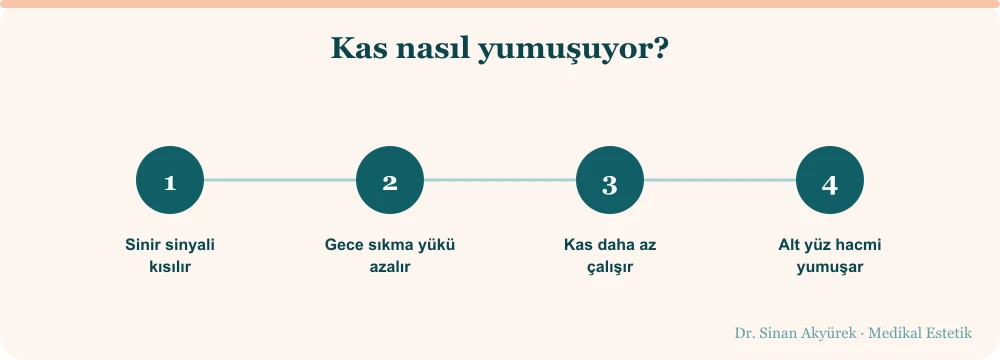
So masseter Botox has two sides. One is function, the other is proportion. The functional side gives the patient easier nights, and the proportional side softens the lower third of the face.
Will the clenching go away completely?
Unfortunately, it won’t. I say this clearly at the very start of the consultation, because this is where expectations break most often.
Botox reduces the strength of the muscle, but it doesn’t take away the urge to clench. That urge is linked to your stress and your sleep pattern. We reduce the damage that clenching does. As the effect wears off, the muscle starts to regain its strength, and the habit picks up where it left off.
I know this from my own experience. I clench my teeth badly myself. For a while it got a lot better. Then it increased again, my teeth started to hurt, and I had to go back to regular Botox.
The other half of the plan is your homework: a night guard assessed by your dentist, less caffeine in the evening, more regular sleeping hours. Masseter Botox is one part of that plan.
Is slimming right for everyone?
No. This is also the least discussed side of the subject.
In a patient whose lower face is already narrow and whose cheeks are thin, reducing the masseter can make the face look more drawn and more tired. In male patients the situation can be completely reversed. An angular lower jawline is what carries a masculine face. Reducing muscle volume there can take away exactly what the patient is hoping to gain. With such a patient the conversation often moves to jawline design, where the line needs to be defined.
Then there is asymmetry. Most of us chew more on one side, and the masseter on that side is thicker. If the dose is split evenly between the two sides, the difference won’t close, and it may even become more noticeable. That’s why, during the consultation, I ask the patient to clench and assess the muscle by hand. We build the plan by touching the muscle.
When a patient comes in wanting the “V-shaped face” they have seen on social media, I sometimes have to say, “in your case this treatment won’t make your face look better.” Performing a popular treatment is easy. I look at whether that treatment suits that face.
The procedure, how long it lasts and when to repeat it
The procedure takes a few minutes. First we ask the patient to clench their teeth and mark the borders of the muscle. Just in front of the masseter there is a thin muscle that pulls the corner of the mouth sideways when you smile. Because Botox spreads a certain distance in the tissue, we stay away from that area; I leave a safety margin of about one centimetre. Then, with a fine needle, we inject at the marked points, at the muscle’s own depth. Anaesthesia is usually not needed. You go back to normal life the same day. That evening there are no particular restrictions apart from heavy exercise and lying face down.
The effect settles in between three and six weeks and lasts four to six months on average. With repeat sessions the interval usually gets a little longer, because the muscle has been working less during that time. We set the dose by looking at the thickness of the muscle, how hard the patient clenches, the proportions of the face and what the patient expects. There is no standard masseter dose that suits everyone.
For the first few days you may feel a slight tiredness when you chew. Cutting through a tough steak may take a little more effort. When it is applied at the right dose and in the right plane, it is not expected to affect smiling or speaking.
Who shouldn’t have it?
We don’t perform this treatment during pregnancy or breastfeeding, in people with a neuromuscular disease, when there is an active infection at the injection site, or when there is a known hypersensitivity to the components of the toxin. Be sure to tell us at the consultation about everything you take regularly, especially muscle relaxants and certain antibiotics.
Sources & Further Reading
- Mayo Clinic — general patient information on bruxism (teeth grinding and clenching): mayoclinic.org
- Cleveland Clinic — an overview of temporomandibular (TMJ) disorders: my.clevelandclinic.org
- PubMed — scientific literature on botulinum toxin and bruxism: pubmed.ncbi.nlm.nih.gov
- Turkish Medicines and Medical Devices Agency (TİTCK) — product and practice regulation: titck.gov.tr