
The Male Jawline: How a Masculine Proportion Is Built
Dr. Sinan Akyürek on jawline filler in men — the proportion behind a masculine jaw, what filler really does, and why facial analysis comes first.

Over the past year, the thing my male patients most often show me on their phones is the sharp jaw profile of some actor or footballer. “Doctor, I want a line like this,” they say. And then usually this follows: “But keep it subtle — I don’t want to look done.” That second sentence matters more to me than the first, because the whole secret of the work is hidden in it. So is a sharp jawline really a question of how much filler you use?
Honestly, no. A masculine jaw is a matter of proportion long before it is a matter of adding tissue. What separates a male face from a female one is not softness but geometry: a wider lower face, a more defined jaw corner, a chin that finishes forward and clearly. So in the exam room I don’t start by thinking in milligrams — I think in angles. Even a tiny amount of filler placed in the wrong spot can make a face look feminine or puffy, while the same amount placed in the right corner can make it read as entirely masculine.
What line does a masculine jawline actually consist of?
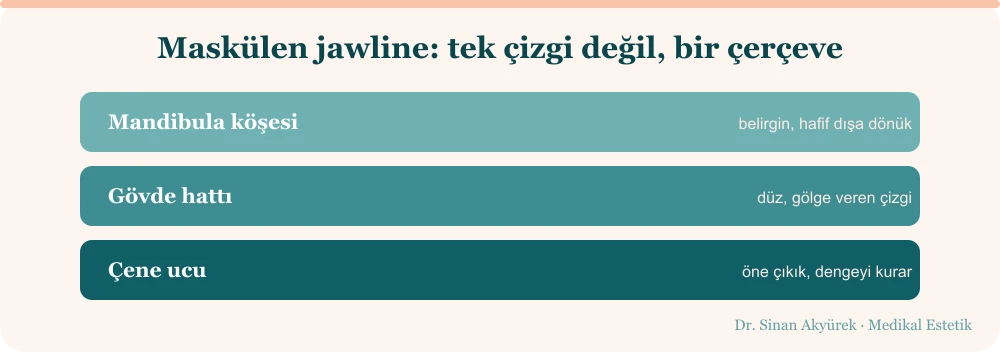
When people say “jawline,” they picture a single line — the one running down from below the ear to the chin. But what we look at is not a line, it’s a frame. I like to break the face into layers to understand this frame, because then it becomes much easier to agree on a plan.
There are three main stops. The first is the jaw corner, the mandibular angle — that corner just below the earlobe. In men it needs to be defined, slightly flared outward and almost upright; this is the point that actually carries the masculine expression. The second is the body line that connects this corner to the chin tip — a smooth, straight edge that casts a shadow. The third is the chin tip itself; in men, a slightly wider and more forward chin restores the balance. Think of these three as the edges of a table: if one edge is missing, the table doesn’t look like a table, and the jaw doesn’t look like a jaw.
This is exactly why jawline filler in men is not a “jaw enlargement” procedure but the completion of a frame. In some of my patients we only sharpen the corner, in others we correct the shadow line between the chin tip and the corner. Rarely all three at once.
How does filler define this line?
Now let me explain the mechanism. We work under the skin, right on top of the bone. The hyaluronic acid filler we use behaves differently depending on how firm it is: a stiff, resistant product placed on the corner and over the bone sits there almost like a structural support, pushing the tissue outward and sharpening the shadow. I compare it to a tent — what stretches the canvas is not the canvas but the pole you place underneath it. The filler is that pole under the skin, stretching the line up and out.
But why on the bone? Because what carries a masculine look is not the fullness at the surface but the clean edge beneath it. A soft filler placed close to the surface inflates the face but does not sharpen it; a filler seated deep, leaning on the bone, splits the light and creates shadow — and that shadow is exactly what the eye reads as a “sharp jaw.” Think of how photographers chase the shadow, not the light — here we are designing the shadow.
Let me say one thing honestly: filler does not change bone. In a very weak, underdeveloped lower jaw structure, there is a ceiling to what filler alone can do. In such a case I tell my patient plainly; making the target look bigger than it is was never my job.
Staying subtle: how is “don’t make it obvious” even possible?
The most common mistake I see in male aesthetics is placing too much product into the jaw corner. The result is usually this: the lower face widens out of proportion, and the patient looks not “strong” but “swollen.” Masculinity is built by direction, not by volume.
My approach is to move in stages. In the first session we lay a measured foundation, let the tissue settle, and if needed add a fine touch a few weeks later. It is always possible to place a little and add more; placing too much and taking it back tires both the patient and the wallet. I just said “take it back” — yes, that is the good thing about hyaluronic acid filler: if the result is not satisfying, it can be dissolved with a special enzyme. This reversibility is a reassuring safety net, especially for my male patients getting filler for the first time.
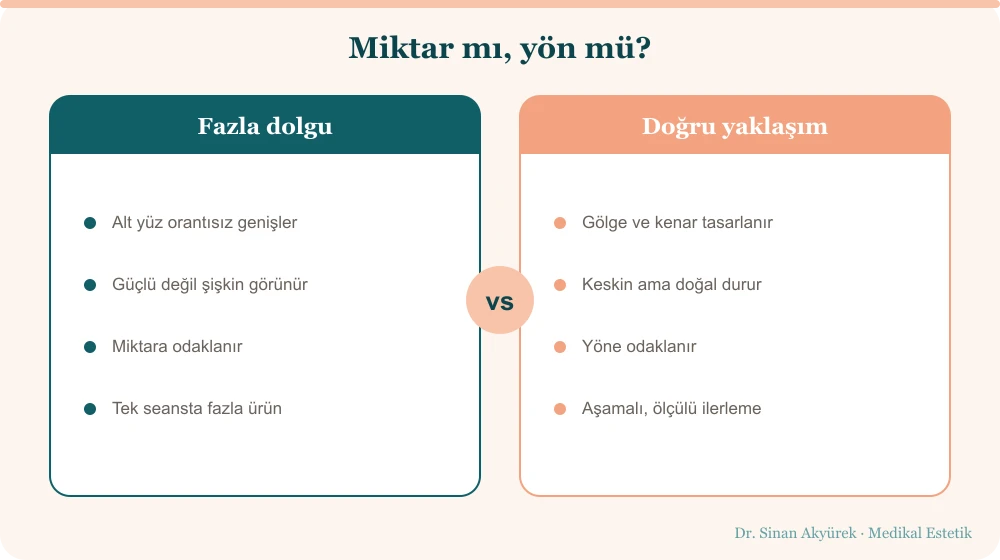
And we must never forget the face as a whole. A sharp jaw often falls flat when it sits next to a receding chin or a vague neck-jaw angle. For some of my patients the real solution is not the jawline at all, but first bringing the profile forward with chin filler. In patients whose jaw muscle has thickened from clenching and squared off the face, what completes the picture is sometimes masseter botox — thinning the muscle a little to let the line emerge. So the right question is not “how much filler,” but “what restores balance in this particular face.”
Why is facial analysis the first step?
None of these decisions can be judged by eye. This is exactly why I never plan filler for a male patient without doing an analysis first. I look at the symmetry of the face, the current jaw-corner angle, the position of the chin tip in profile, the neck-to-jaw transition, and — something most people skip — how this line moves when the patient smiles and speaks.
Because a line that looks good in a static photo can look strange once the face moves. A masculine but natural result only emerges when the face is read as a whole. Analysis is like a compass to me; I decide where and how much to place not by milligrams but by that compass.
Finally, let’s be clear about expectations. Jawline filler is not a permanent procedure; depending on the product and the person’s metabolism, its effect fades over time and needs refreshing. I don’t see this as a flaw but as an advantage: as the face ages, the need changes, and we update the plan with that change. The aim is not to lock in a fixed mold, but to build the most balanced version of your own age.
Sources & Further Reading
- Turkish Ministry of Health / TİTCK — regulations on medical device and injectable product safety: titck.gov.tr
- American Academy of Dermatology — patient information on soft-tissue fillers: aad.org
- Cleveland Clinic — general information and safety on dermal fillers: my.clevelandclinic.org
- PubMed — clinical literature on hyaluronic acid fillers in facial aesthetics: pubmed.ncbi.nlm.nih.gov
A sharp jaw in men is the work of the right shadow, not of more filler. Masculinity is built by direction, not by volume.
Want to talk through the masculine proportion of your jawline? Plan a free consultation on WhatsApp.