Why Do Brown Spots Appear on the Face, and How Are They Lightened?
Dr. Sinan Akyürek explains why sun spots, melasma and post-inflammatory marks form, why they are not treated in summer, the steps used and what your homework is.

Every year when October arrives I hear the same sentence in consultations: “Doctor, my spots multiplied over the summer, let’s clear them right away.” They are right, the sun worked all summer and the result is on their face. But I do not reach for a device straight away. First we look in the mirror together, and then I ask one question: which kind of spot is this? Because what we call pigmentation treatment is not a single procedure. If we start without knowing which spot we are dealing with, the patient ends up unhappy and so do we.
In this article I will first explain what a spot is and why the body makes it. Then we will talk about the methods we use to lighten it, why we do not do this in summer, and the part of the job that stays with you.
Why does the body make that spot?
To be honest, a spot is not a mistake. It is a decision the skin makes. When you are exposed to the sun, to high altitude or to screens for hours, your skin receives a constant signal. And your skin says: “I already have a world of work to do inside. If these rays keep coming they will damage my cells. I had better not let them in.” So what does it do? It produces pigment in that area. What people call a spot, and what we call melanin, is actually a shield. It catches the incoming light and stops it passing through. Up to this point everything is working as designed. The problem is that we do not like that shield, because we think it looks bad.
So if everyone goes out in the sun, why does not everyone get spots? This is the important part. The spot is visible on the surface, but the factors that trigger it are usually somewhere else. People with low antioxidant capacity, heavy smokers, people under long-term stress, pregnant women and people fighting an illness at the time produce pigment far more easily. I see this often in my patients who work as flight attendants: ultraviolet exposure is high in flight, sleep is irregular and the body is permanently on alert. Two people get the same sun, one develops spots and the other does not. The difference usually sits behind the skin, in the organism itself.
Is every spot the same spot?
No. This is the first thing I separate in the consultation, because the three follow different paths.
- Sun spots: spots that accumulate with sun exposure over the years, with clear borders, sitting in the upper layers of the skin. This is the group that responds most clearly.
- Melasma: hormonal in origin, usually symmetrical on the forehead, cheeks and upper lip, reaching deeper into the skin. Pregnancy, the contraceptive pill and sun trigger it. It has a tendency to come back, so we have to think long term.
- Post-inflammatory marks: the brown trace the skin leaves behind after acne, an injury or a harsh procedure, as if to say “something happened here”. Any intervention made while the skin is still sensitive can make this larger.
And then there is the spot that fits none of these. If I see a spot that is new, has irregular borders or is changing colour, I put the aesthetic plan aside and ask for a dermatology assessment first. Until that comes back clear, we do not point any device at that spot.

Why do we not do this in summer?
This is the sentence I get the most pushback on: “Doctor, can I not come in June?” I do not say it is impossible, but I explain this. Starting pigmentation treatment in summer is like trying to drain a pool with three taps at the bottom while two taps keep filling it from the top. We lighten the spot in one session and the sun puts it back within two weeks. A great deal of effort goes in, the patient is unhappy, we have failed, and everyone is miserable with the whole thing.
So what we do in summer is different. We close the hydration gap, we support the skin with antioxidants, we get the sun protection routine properly in place. In other words, we turn the filling taps down. The actual lightening work we leave for the months when the sun weakens. October to April is pigmentation season for us. Device-based procedures such as fractional laser are done in this window anyway.
From the surface to the deeper layers: how do we lighten it?
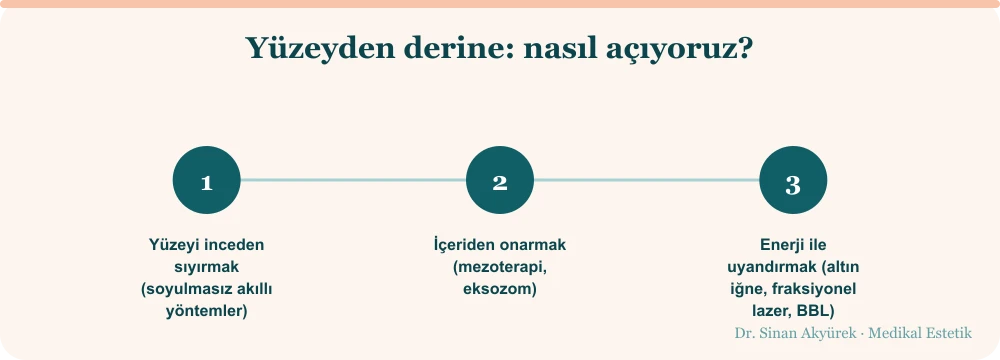
We build the protocol around the type and depth of the spot. We rarely stay with a single method; we go step by step.
- Gently lifting the surface: because sun spots settle in the upper layers, taking that surface off lightly in the first step gives good results. This used to be done with harsh peels that kept people at home for days. Today there are smarter methods such as PRX-T33 that work without creating visible peeling; you walk out and carry on with your day.
- Repairing from within: with mesotherapy we carry moisture and antioxidants into the skin, and once the dryness is resolved pigmentation slows down too. In post-inflammatory marks and sun spots, in my experience the response we get from exosome applications is somewhat stronger; we are essentially sending the skin the signal “you do not need to make this much pigment here”.
- Waking the tissue with energy: for deeper spots, and where collagen loss is part of the picture, devices such as gold needle radiofrequency, fractional laser or BBL come into play. We give the skin a controlled, point-by-point stimulus; the healthy tissue in between repairs the damaged tissue next to it, carrying the spot away with it, and firming comes on top.
A plan of around three sessions is common, but the number changes with the type of spot. In darker skin the risk of post-procedure darkening is higher, so we keep the settings cautious. Do not expect a big difference after the first session; the lightening builds up as the sessions accumulate.
What happens if you rush?
Here I have a warning. If you have an aggressive pigmentation treatment before the skin has come through its sensitive, injured phase, your body reasons like this: “I made pigment here, and even that was not enough, so something very severe must have happened. Let me make more.” The result is a larger, darker spot. In melasma this trap is even more pronounced; the aggressive approach that works on a sun spot can make the picture worse there.
This is also why, after some methods, the spot darkening temporarily for a few days is a stage we expect. My patient calls in those days and says “doctor, the spot has got worse”. That is normal. The skin is pushing that pigment to the surface and shedding it. During that period you wait, without skipping sun protection even once.
The part of the job that stays with you
Let me be honest: pigmentation treatment does not promise to erase spots completely. Our aim is to reduce their appearance and even out the skin tone. In superficial sun-related spots the difference is clearer; in melasma the process is long, and the tendency to recur comes from the nature of the condition itself.
And there is this. We lightened the spot, it looks good, but if nothing in your daily life has changed, the same sun, the same screen, the same cigarettes and the same lack of sleep stimulate the skin all over again. And the skin makes the same decision again. The spot comes back, either in the same place or somewhere new. This is why, with pigmentation, there is a part the doctor does and a part that is your homework. Sunscreen is part of the protocol itself, and we plan it together with the sessions. The moment you stop protecting, the lightening we achieved comes back. In the patient who does the homework the result holds; in the one who does not, we start again the following summer.
Sources & Further Reading
- American Academy of Dermatology — patient information on dark spots and melasma: aad.org
- Cleveland Clinic — what melasma is, its causes and approaches: my.clevelandclinic.org
- PubMed — literature on the treatment of melasma and solar lentigines: pubmed.ncbi.nlm.nih.gov
- Turkish Medicines and Medical Devices Agency (TİTCK) — product and practice regulation: titck.gov.tr